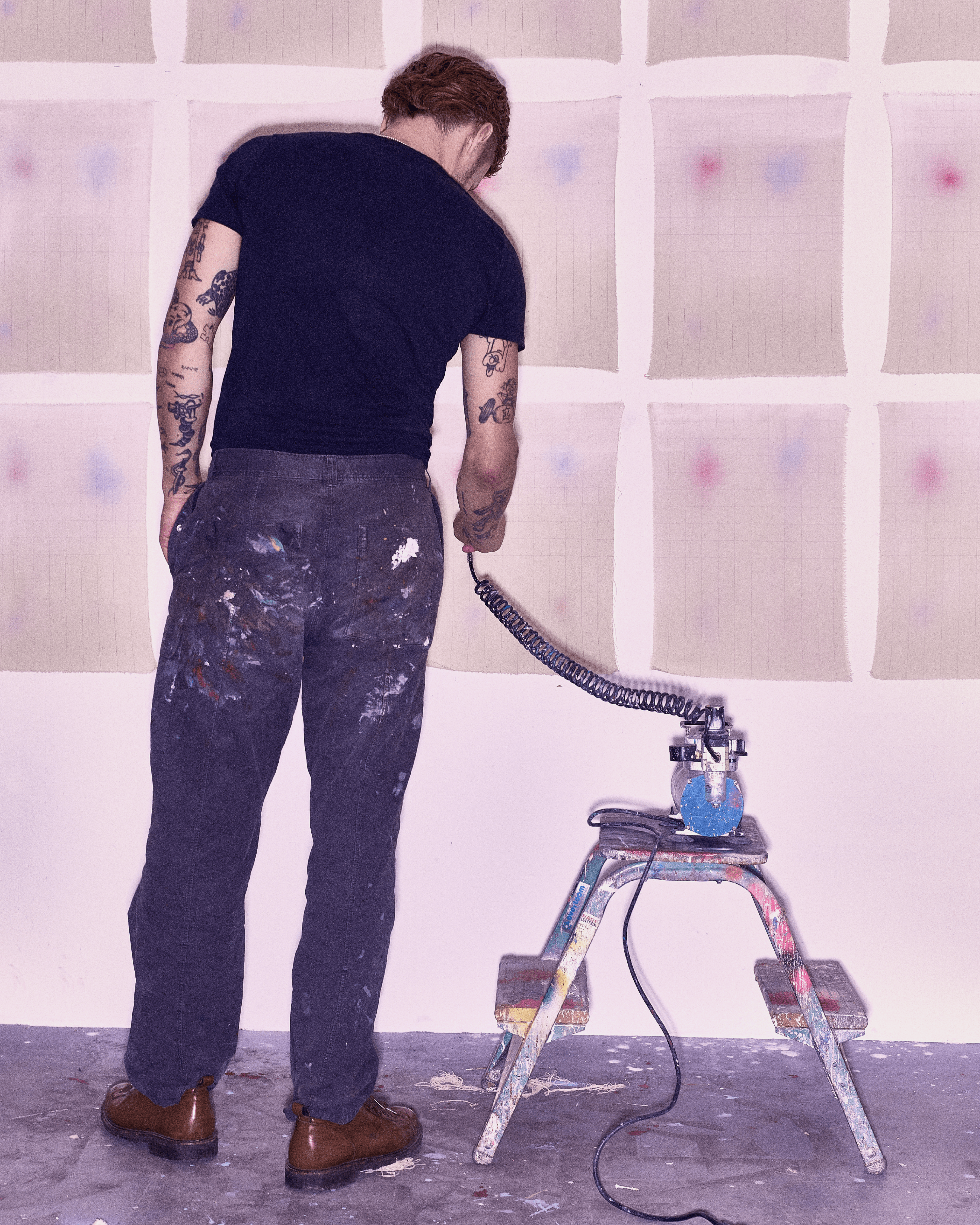
Jesse Fischer: Murky Waters
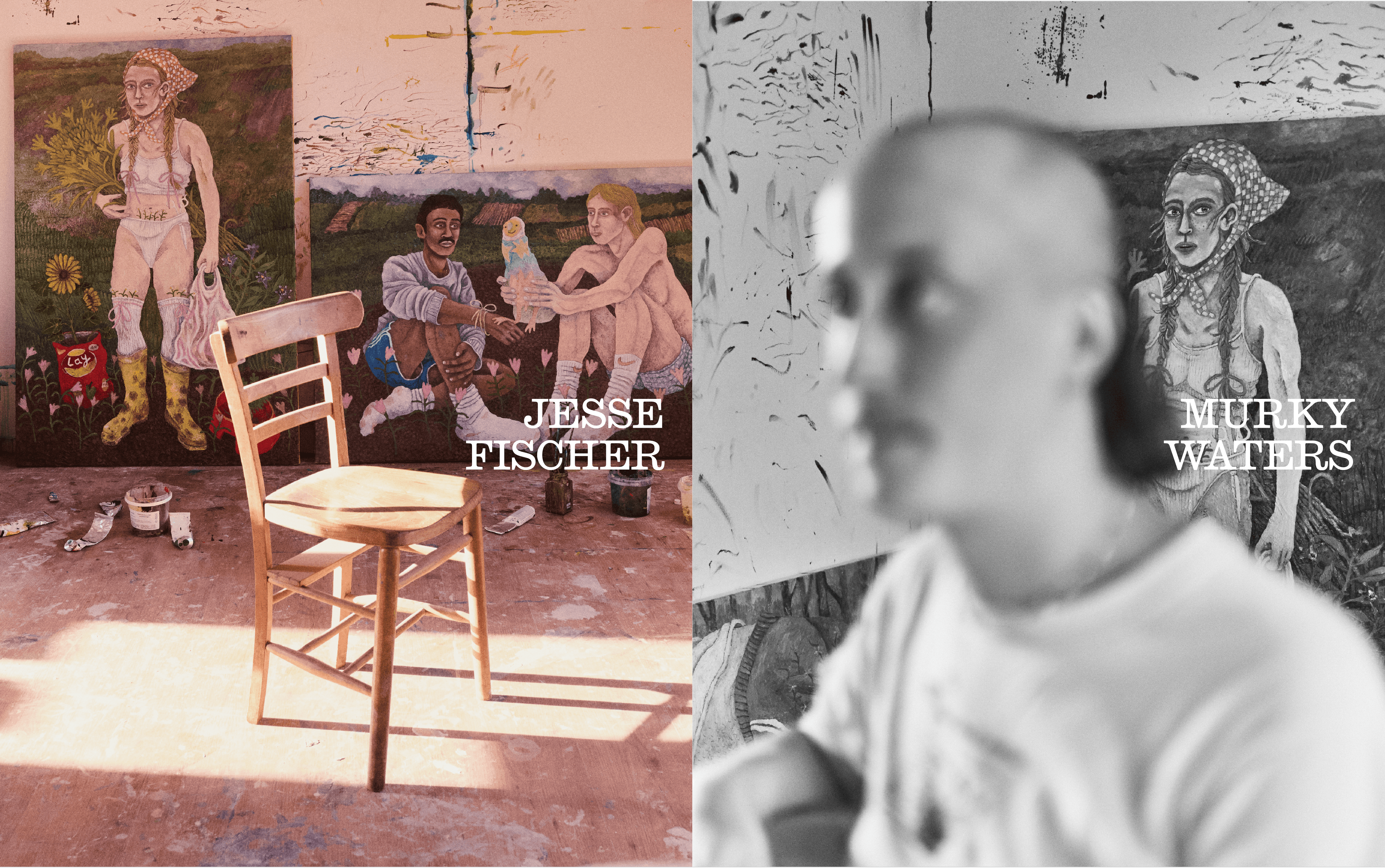
Love locks on bridges, roadside memorials. Small, often unnamed rituals. Jesse Fischer (1996), who lives and works in Tilburg, paints where these contemporary gestures meet ancient folktales and mythologies. Amongst other, Slavic, Dutch and Sumerian folklore emerge in present day scenes, making his works feel like a present under pressure.
You move between ancient and current references. How do they sit together?
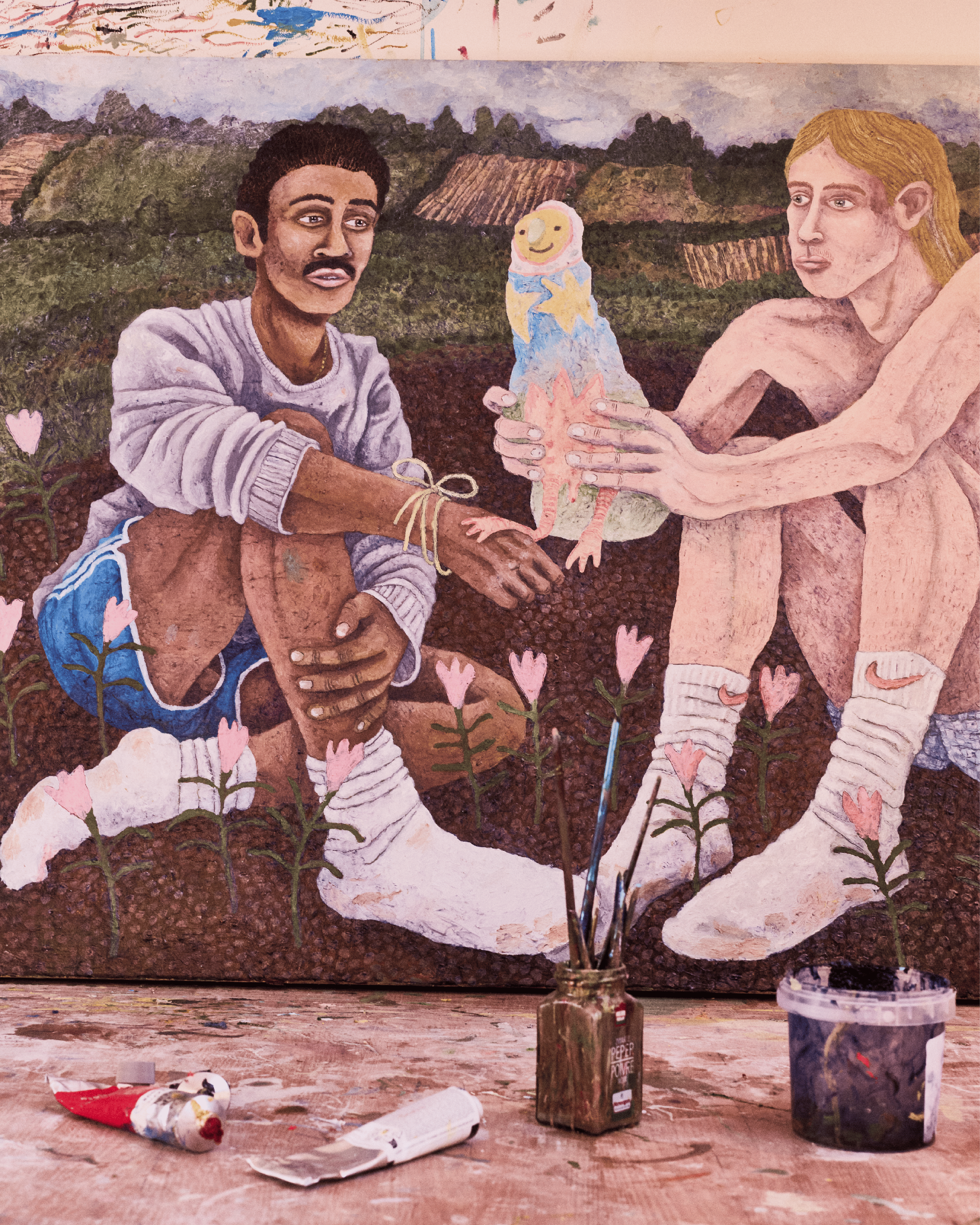
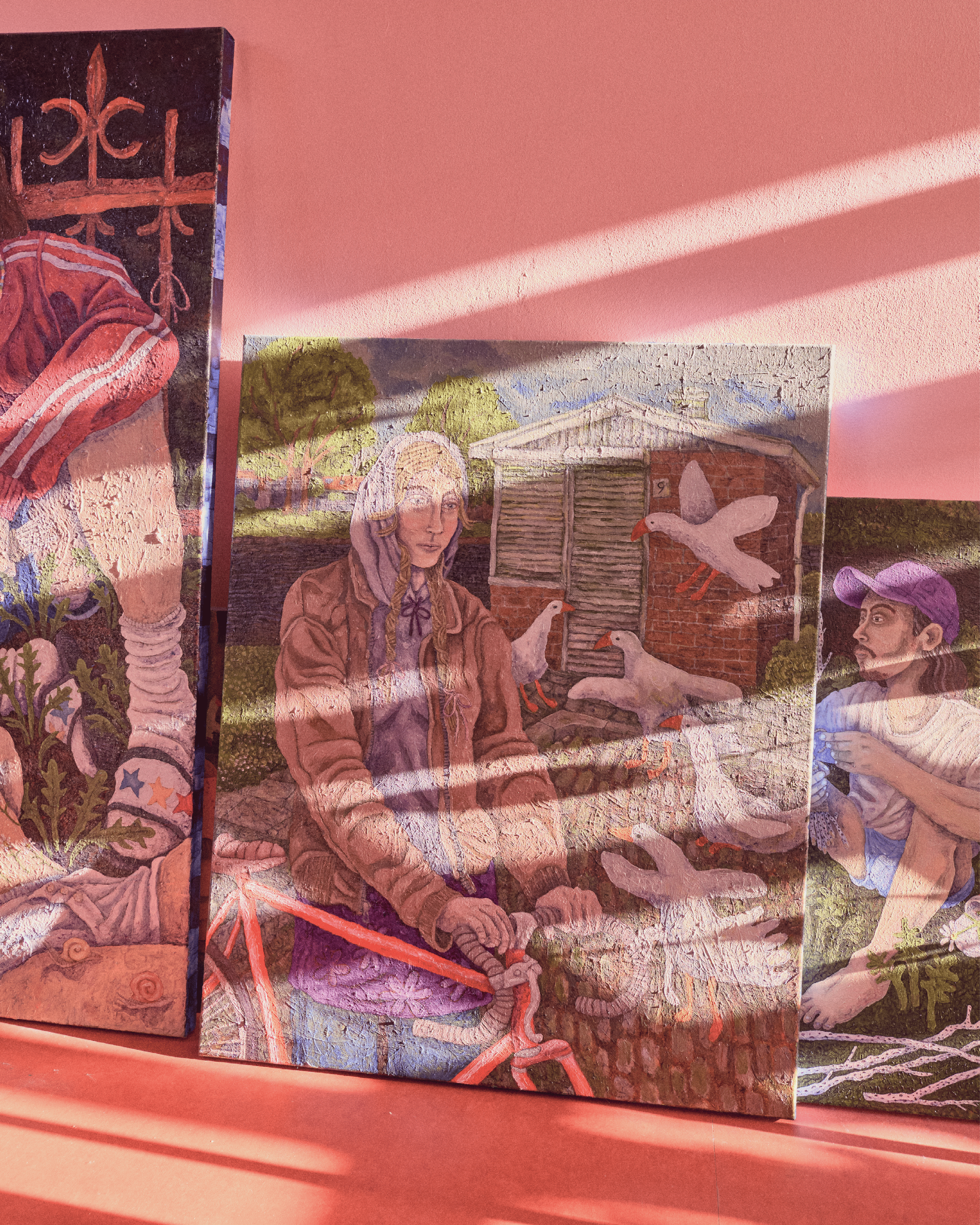
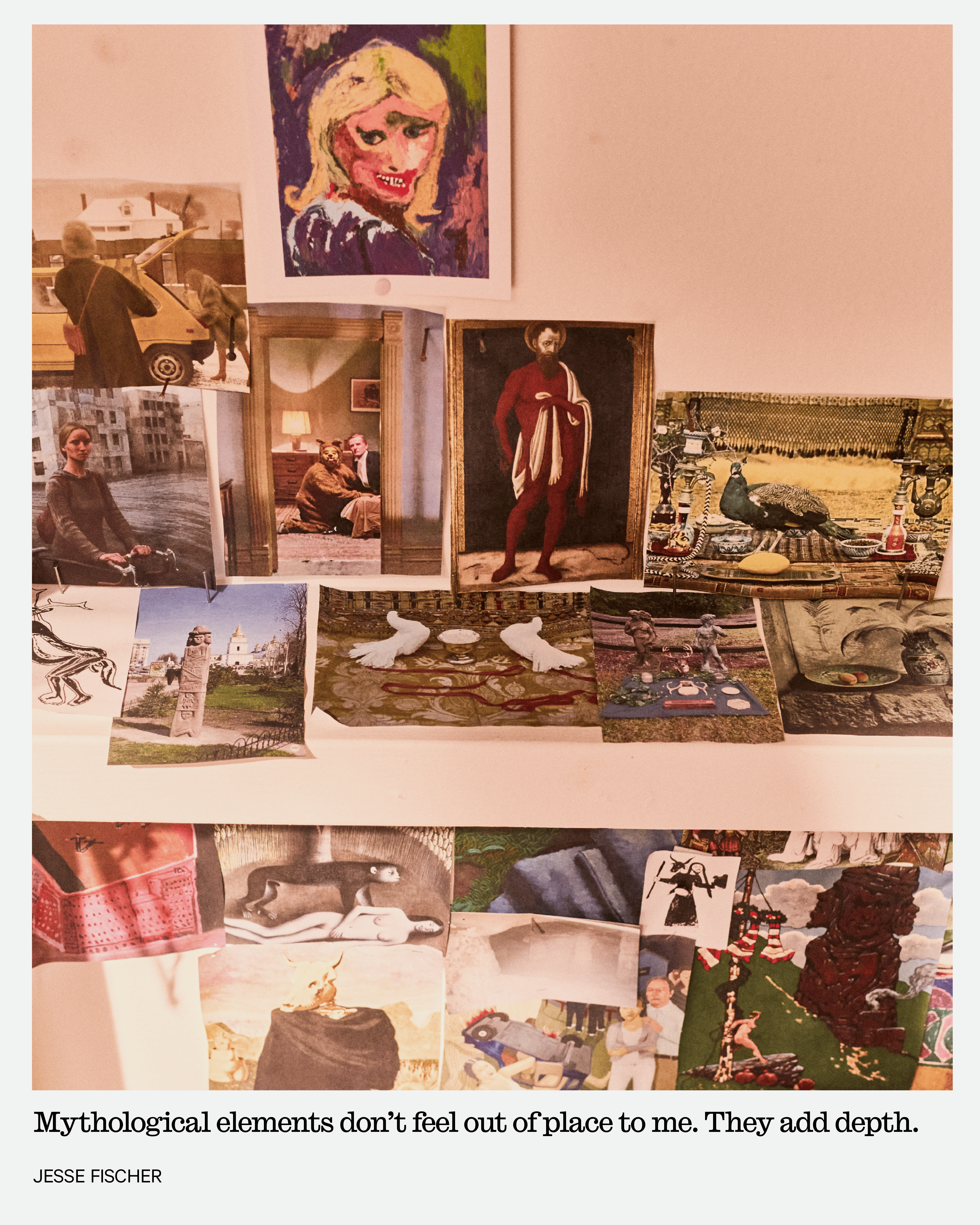
When working on a new series of work, I often think in terms of a topos: a kind of mental space built from things I find beautiful, intriguing, or exciting. I take my personal surroundings, like the city I live in, and populate them with elements from different cultures, both historic and contemporary. For example, Pan, the Greek god of the wild, might appear as a boy covered in snails and flowers, asleep in a city park. Or two women walking home from a night shop might speak with a deity. These mythological elements don’t feel out of place to me; they add depth and density to the present, offering ways to experience the world differently, here and now.
This depth to the present, where does that start for you?
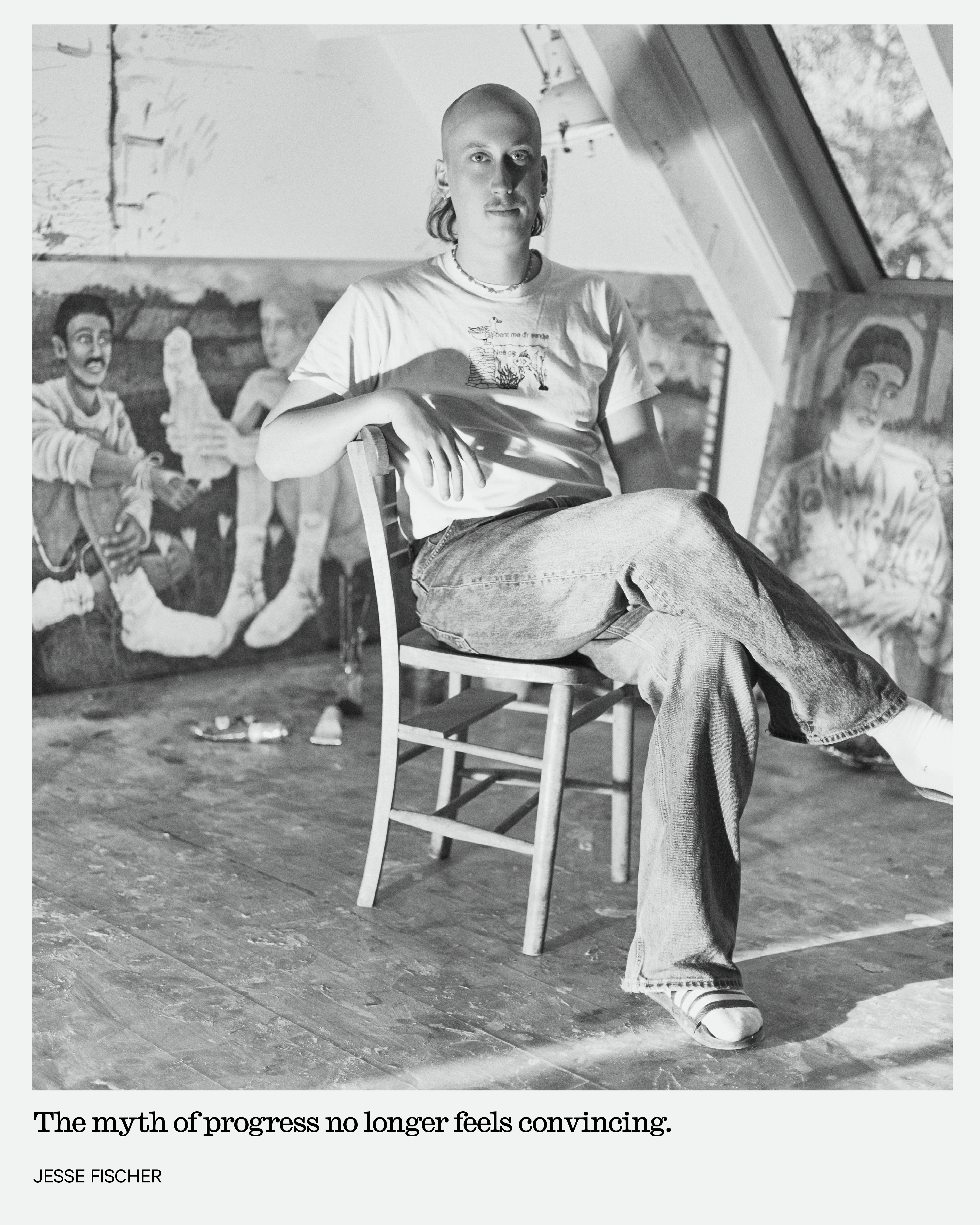
That doesn’t start with a clear answer for me. It begins with the feeling that many things we were raised to believe in — ideological, religious, cultural — have lost their believability. Faith has long been fragmented, and only recently have we fully started to feel what that loss creates: gaps in shared meaning. At the same time, the myth of progress no longer feels convincing. Hard work doesn’t guarantee a stable future. Political orders are shifting, ice caps are melting, deserts are expanding. The ground beneath our feet is moving, and everyone can feel it. My work begins in that tension. I’m not looking to return to a lost spiritual unity, nor am I interested in cynicism. I think we’re searching for new images and rituals that can carry meaning again. Painting is my way to cope with that and making that search visible.
Mythological elements don’t feel out of place to me; they add depth and density to the present.
What kind of thinking is possible in painting that isn’t available elsewhere?
While painting, I constantly shift how I look at the work: through composition and color, depiction, poetry, or meaning. I also imagine how a viewer might encounter the image and what narratives they might form. Painting happens from different states of being — tired or uncertain, energetic or confident — and each shifts how I see the work. This constant change of perspective is what makes painting rich for me. Where language pushes toward clarity, painting allows ambiguity. I can hold intuition, doubt, desire, and irrationality at once, without resolving them. Painting isn’t about conclusions, but about keeping this fluidity alive.
You also work with ceramics. What carries over into the paintings?
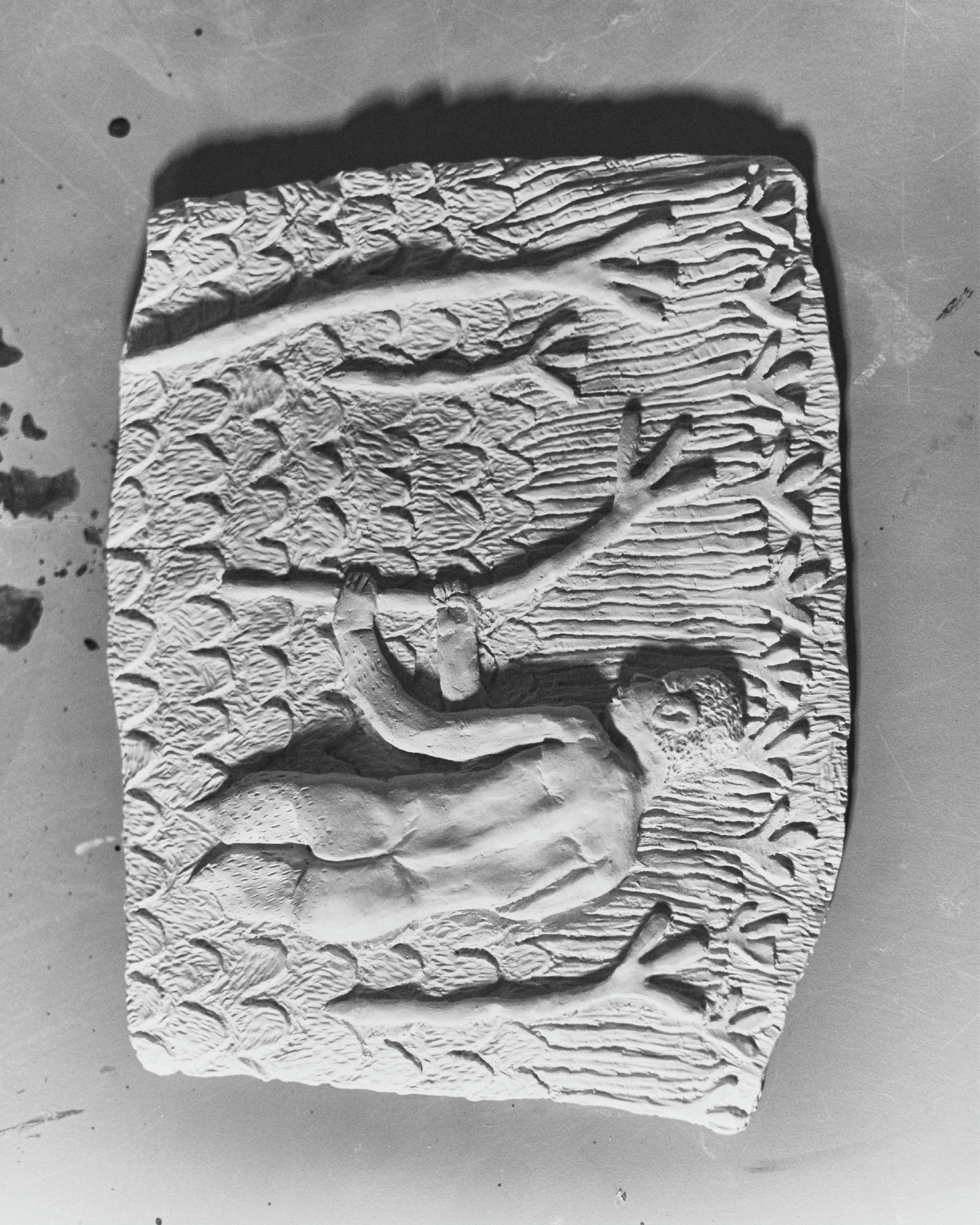
I’m still relatively new to ceramics and exploring how I want to use the medium. I’ve long been inspired by Sumerian bas-reliefs and enjoy the challenge of creating three-dimensional images on a two-dimensional surface, which suits my painting style well. Recently, I’ve made sculptures inspired by mythological or folkloric figures, like Sleipnir, Odin’s six-legged horse, or a goblin that is also the Baba Yaga hut from Slavic tales. I later incorporate these forms into my paintings by painting them into the scenes. In that sense, ceramics carries over quite literally: the painting becomes less a flat image and more a sculptural object, embracing texture and three-dimensionality.
The ground beneath our feet is moving, and everyone can feel it. I think we’re searching for new images and rituals that can carry meaning again.
What’s one detail about this edition you don’t want anyone to miss?
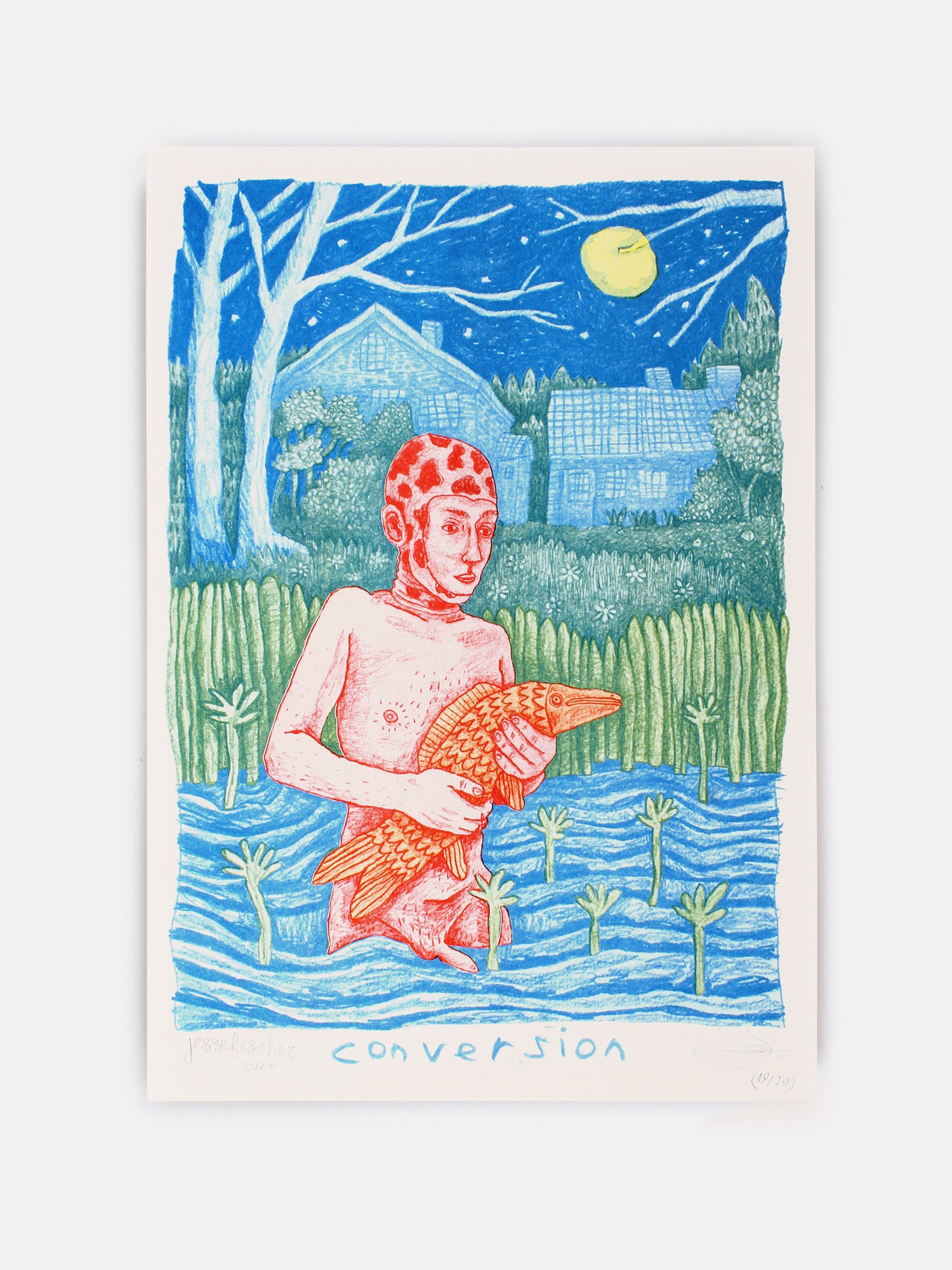
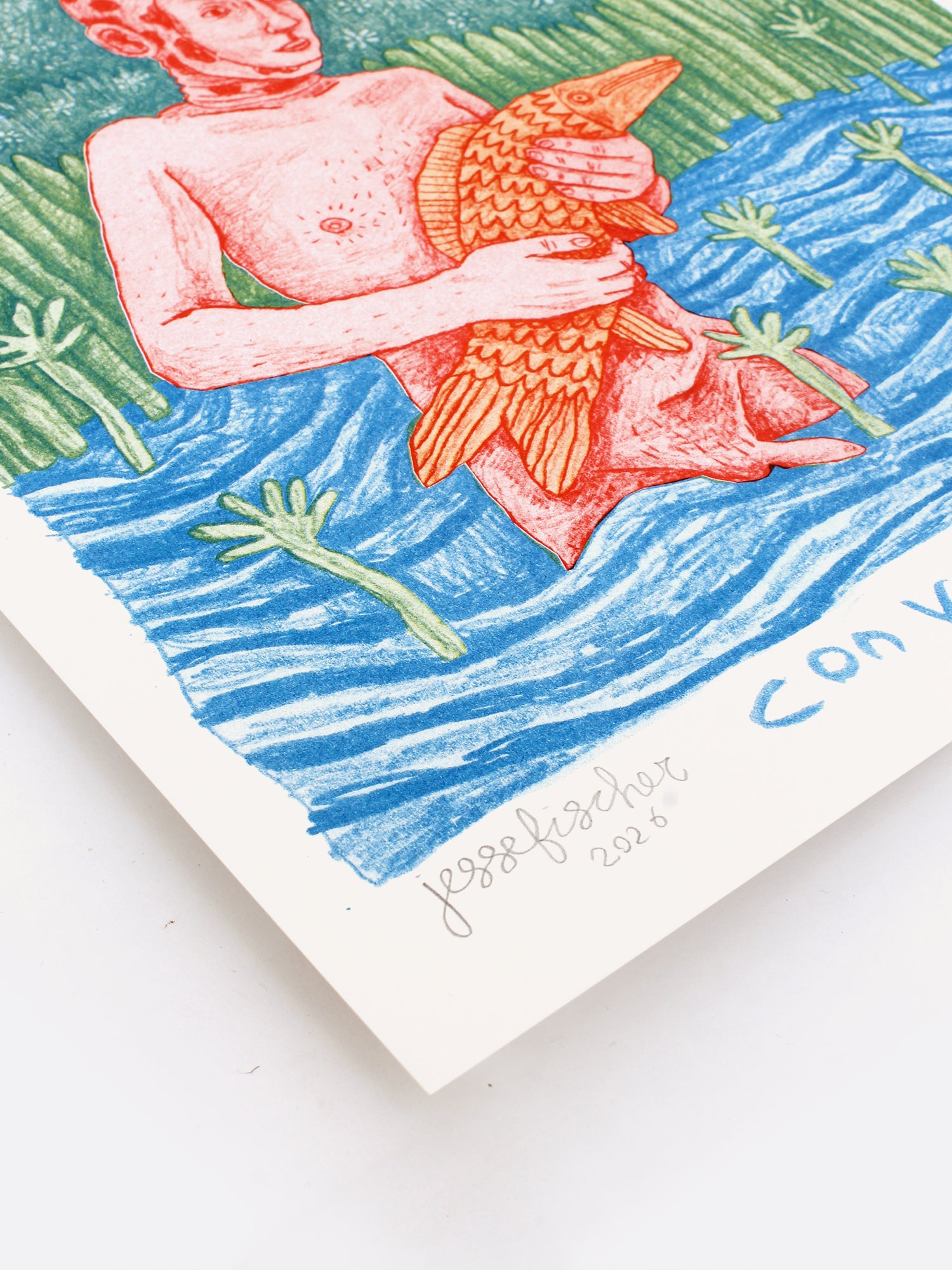
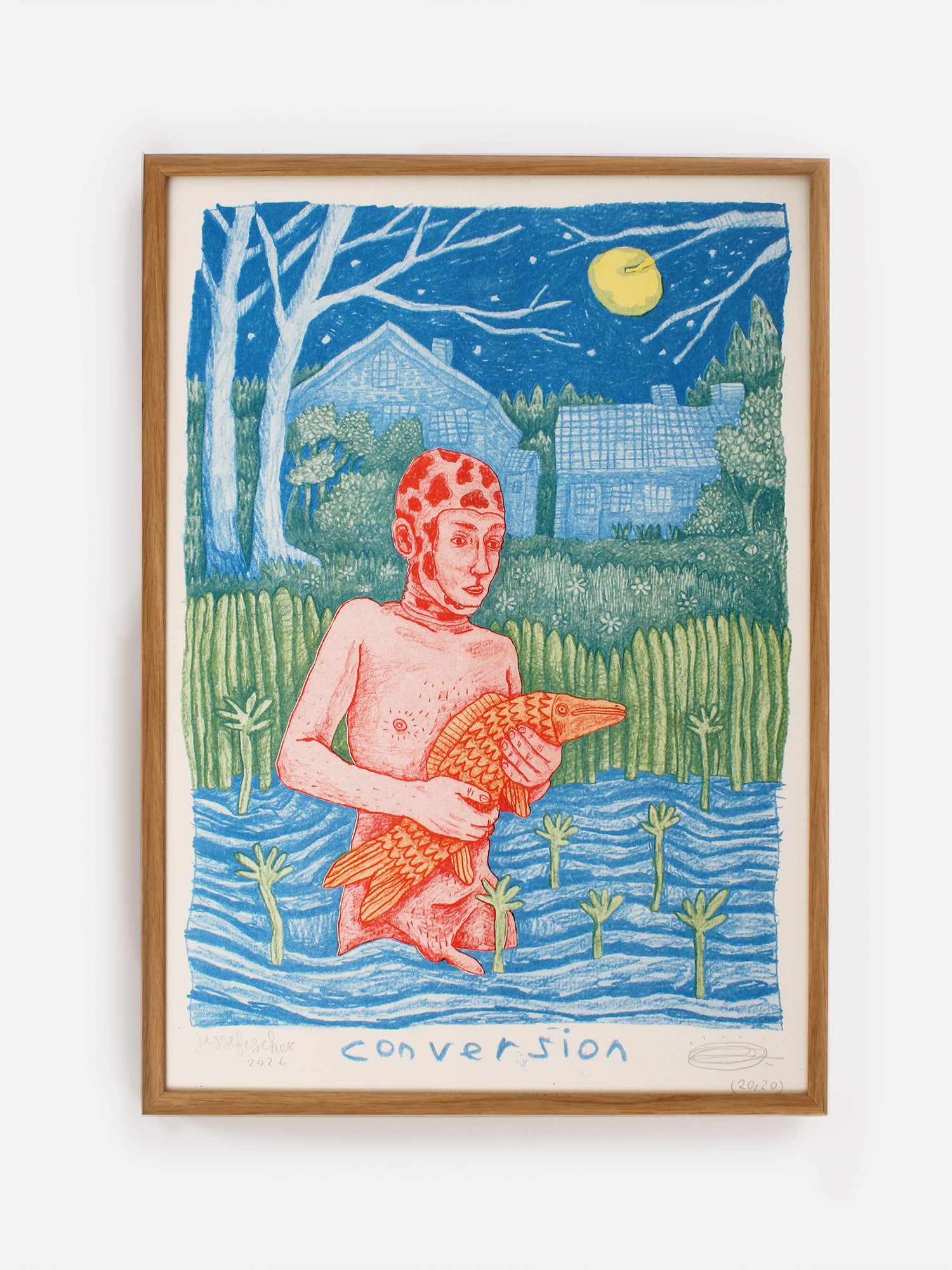
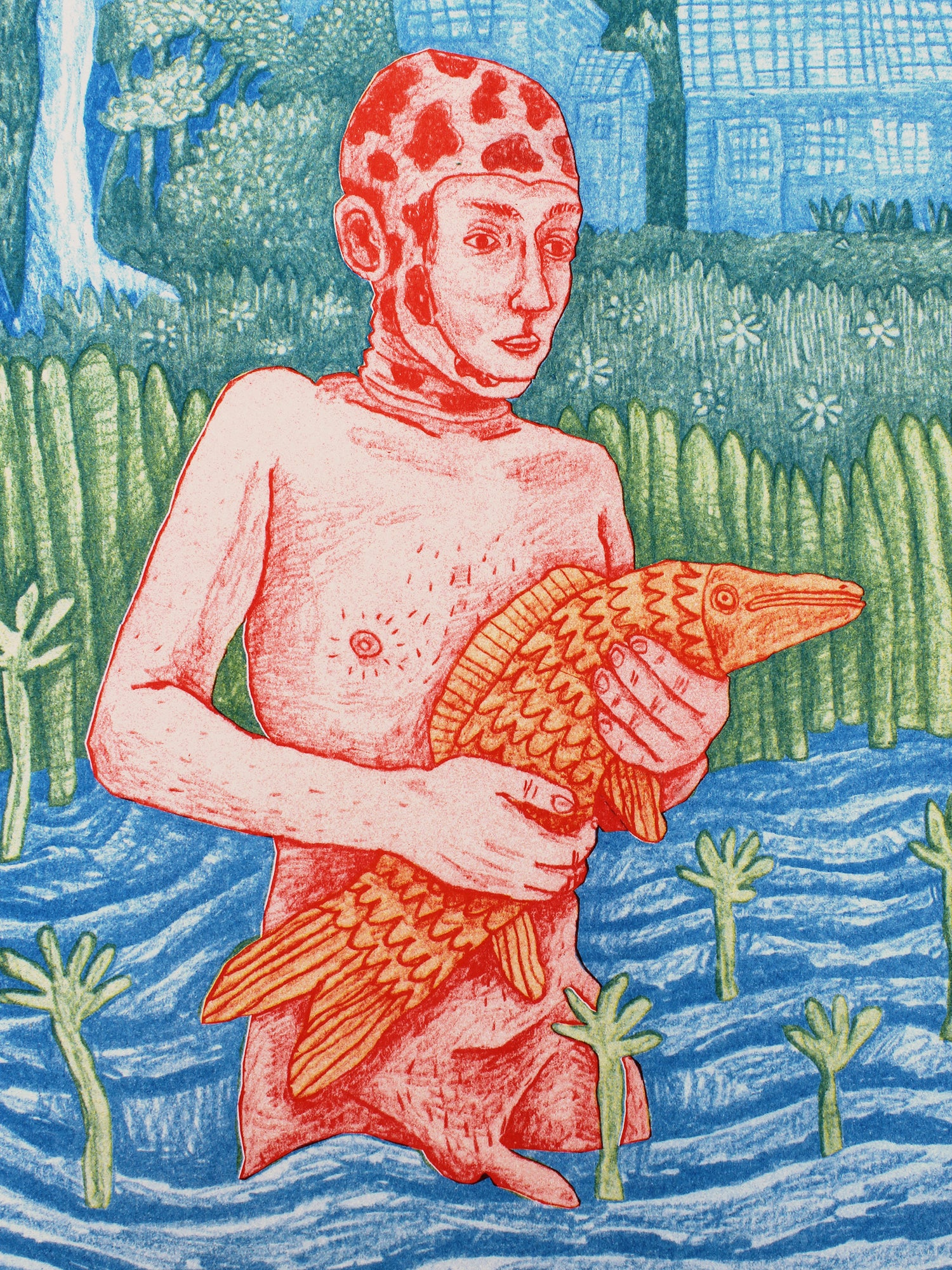
As the title Conversion suggests, the work centers on a moment of internal transformation: the decision to change one’s state of being with full belief. Not a change of scenery, but something inward. I hope it resonates with someone in that awkward, vulnerable in-between, when the old no longer works and the new hasn’t fully taken shape yet.
Words and images by Kees de Klein
Photography assistant: Aryan Hamyani
Edition of 20
- 29.7 x 42 cm
- Risoprint in three colours
- Freelife Vellum 215 grams paper
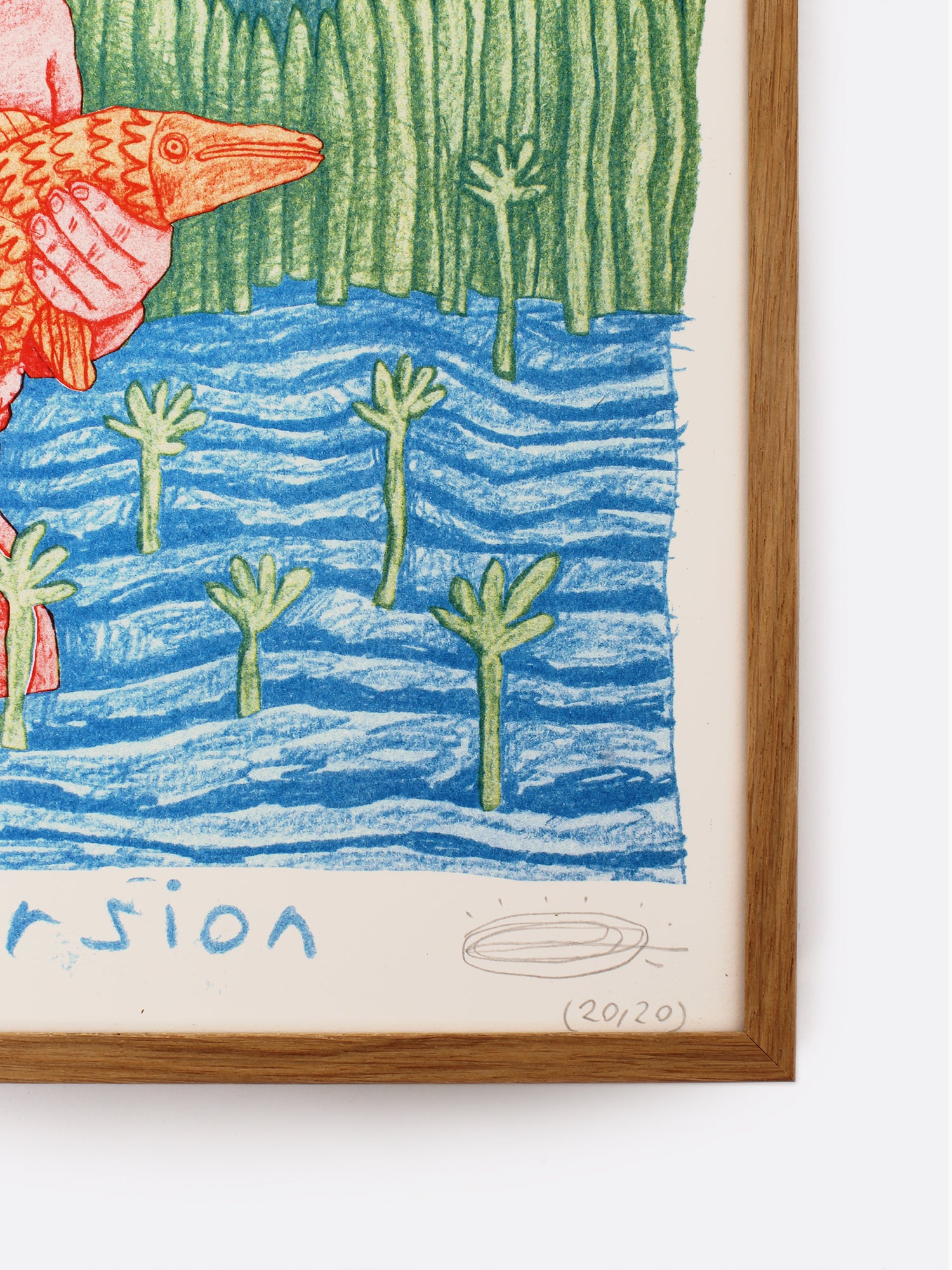
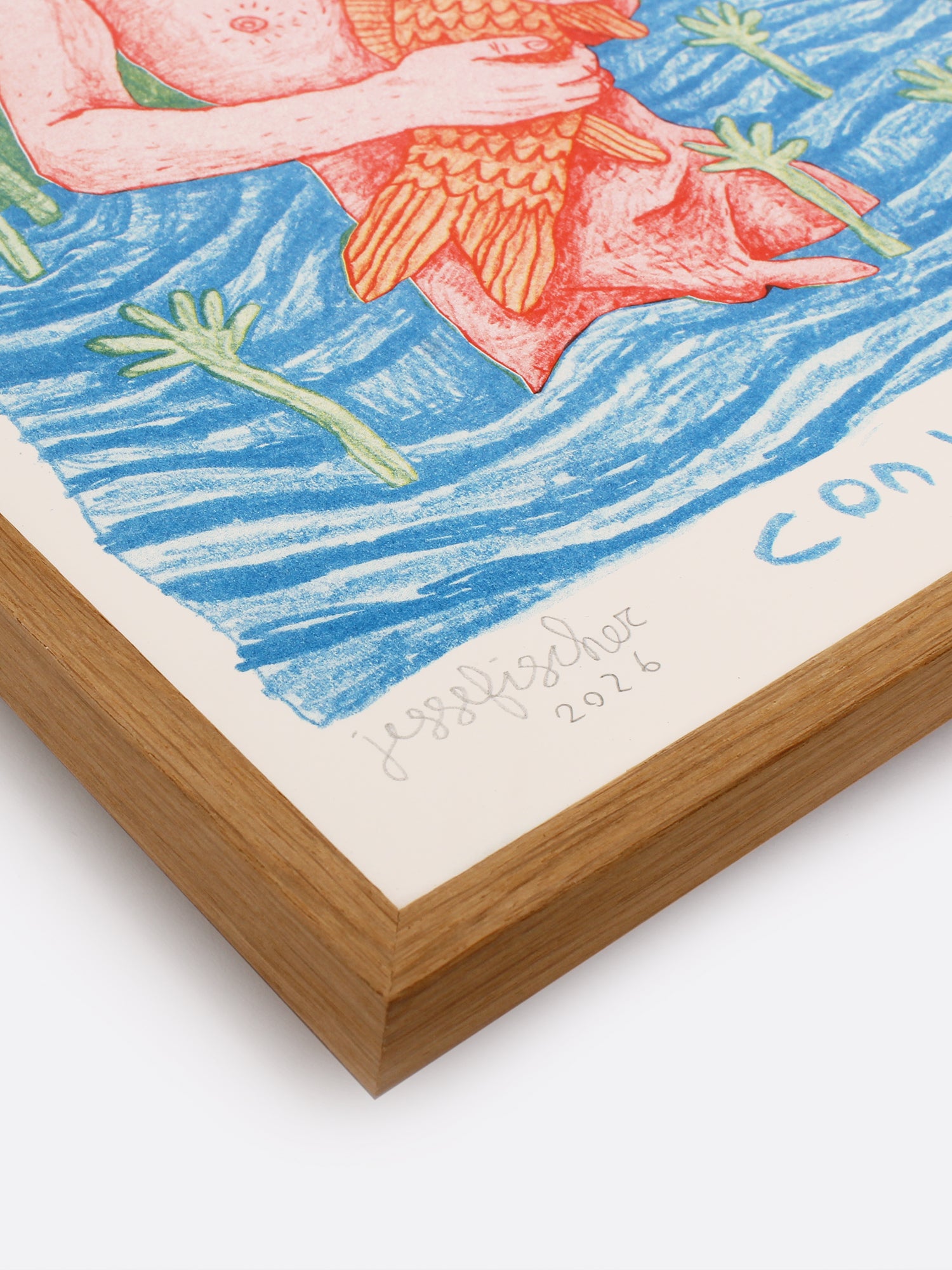
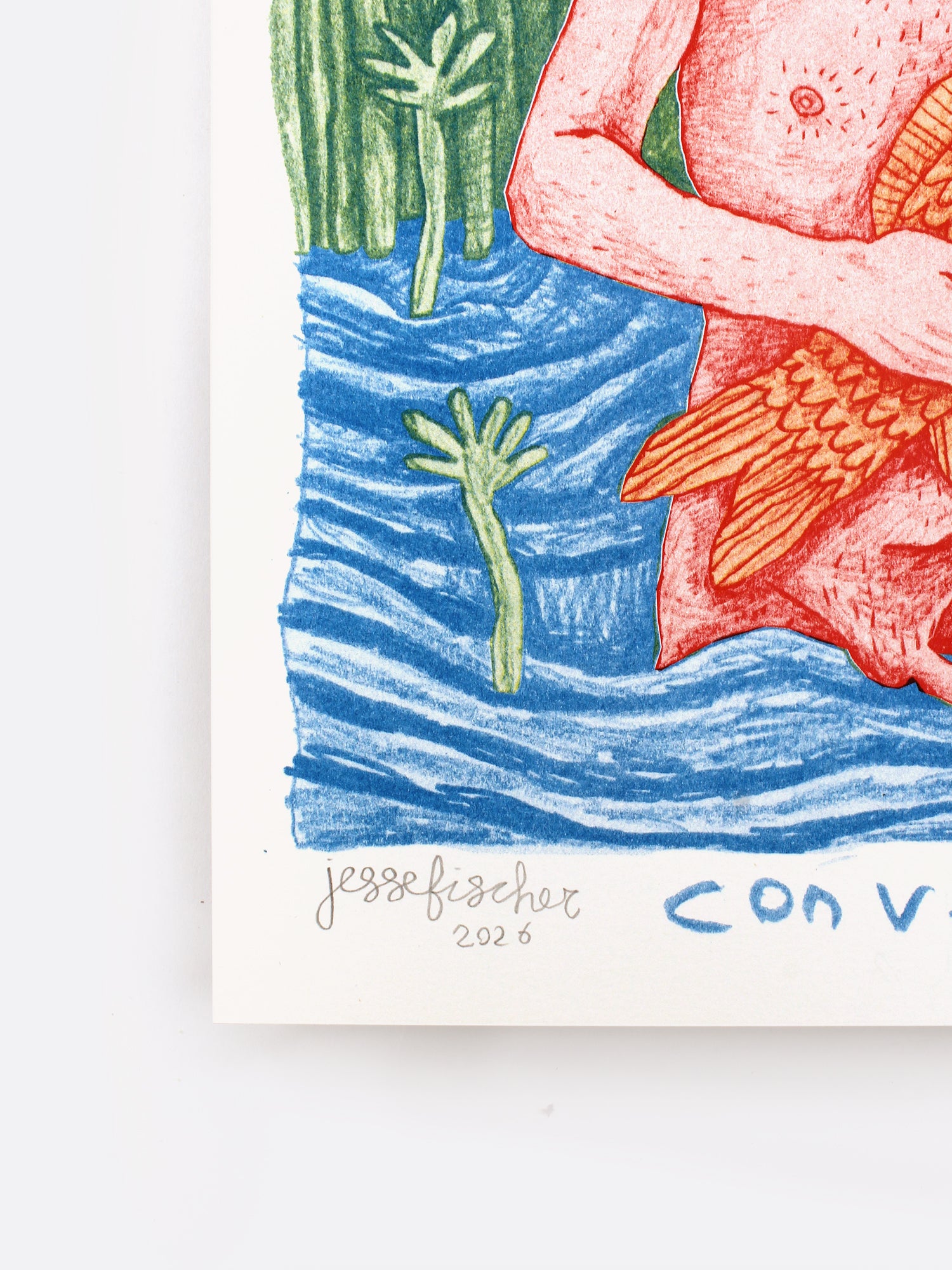
- Signed and numbered by the artist
- Optionally framed with Artglass AR 70 (longer delivery times)
Jesse Fischer grew up in a village surrounded by farmland, grassy fields, mud and trees. As a child, he spent his time adventuring outside: catching frogs and birds, trespassing, spying on farmers, mapping every little secret spot. Years later, he returned to this place from his past, full of meaning and on-the-go mythology, expecting this sense of vibrancy to have faded. But, to his surprise, the place was still as mysterious.
Conversion centers on a moment from this recent visit, at a local river he used to play at. Next to it stands an abandoned shed that has remained unchanged over twenty years. As a child, Jesse never dared to enter it, and when he approached it now, something stopped him once again. In line with its title, the work uncovers a familiar in-between state, when the old no longer works, and the new has yet to fully take shape.
Pickup available at Unfair Amsterdam
Usually ready in 5+ days
Conversion
Framed
Unfair Amsterdam
WG-plein 13
1054 RA Amsterdam
Netherlands
Read more